
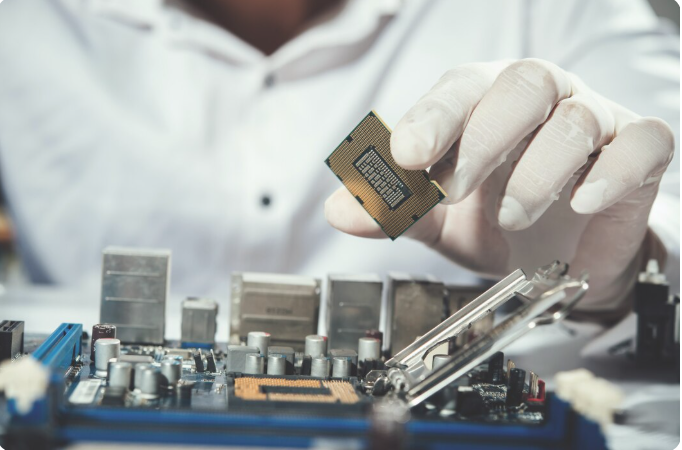
A standard FR-4 laminate starts to soften near 130°C — well below the 245-260°C peaks of a lead-free reflow oven and the under-hood heat of an EV inverter. That gap is why high-Tg PCB manufacturers have moved from a niche to a procurement priority for any board that sees heat, power, or repeated thermal cycling.
Boards built on high-Tg material (a glass transition temperature at or above 170°C) hold their shape through assembly and field life, resisting the delamination, pad lifting, and barrel cracking that quietly kill reliability.
This guide ranks 10 manufacturers for 2026 on the metrics that actually decide thermal performance: laminate qualification, layer count, certifications, testing depth, and the industries they already serve. You’ll get a quick-compare table, a short note on how the list was built, a profile of each company, and a buyer’s checklist for matching a supplier to your project. Specs first, marketing second.
High-Tg PCB Manufacturers at a Glance
Company
HQ
Specialty
Best For
Lead Time
Shenzhen China
Turnkey high-Tg fab + assembly, 1-56 layers
One-stop prototype-to-volume
Quick-turn to 2-3 wks
TTM Technologies
Santa Ana, USA
High-rel A&D, RF/microwave, automotive
Defense-grade, high-rel volume
Std 1-3 wks
Wurth Elektronik
Niedernhall, Germany
Heat management, thick copper, microvia
EU heat-managed boards
Std 1-3 wks
AT&S
Leoben, Austria
HDI, IC substrates, embedded power
Miniaturized high-power modules
Volume 3-6 wks
Sanmina
San Jose, USA
High-speed, high-rel PCB + EMS
Mission-critical telecom/medical
Std 2-5 wks
Schweizer Electronic
Schramberg, Germany
Power electronics, heavy copper, embedding
Automotive power & high-current
Volume 3-6 wks
Unimicron
Taoyuan, Taiwan
HDI, ABF substrates, high volume
High-volume HDI & substrates
Volume 3-6 wks
Sierra Circuits
Sunnyvale, USA
Quick-turn high-rel prototypes
Fast prototypes & low volume
1-5 days
Ibiden
Ogaki, Japan
FC-BGA substrates, automotive HDI
Substrate-grade reliability
Volume 4-8 wks
NCAB Group
Stockholm, Sweden
Vetted-factory production, IMS/HDI
Quality-managed global sourcing
Std 2-4 wks
Lead times above are indicative industry ranges, not contractual quotes; confirm current capacity with each supplier.
How This List Was Built
This list weighs five factors over brand size. First, material qualification — whether a fabricator runs validated high-Tg laminates such as Isola 370HR, Shengyi S1000-2, or ITEQ IT-180A and publishes Td and CTE data. Second, capability range: layer count, heavy copper, HDI, and metal-core options. Third, certifications tied to reliability, including IPC-A-610 Class 3, AS9100, and IATF automotive standards. Fourth, testing depth — AOI, X-ray, ICT, and thermal-stress methods such as T260/T288 delamination. Fifth, proven coverage in automotive, aerospace, medical, and power electronics. Companies appear in no strict performance order; each suits a different project profile.
1. PCBSync
PCBSync is a Shenzhen turnkey house that folds high-Tg fabrication, assembly, and component sourcing into a single workflow. Publicly listed customers include Honeywell, Siemens Healthineers, and Analog Devices.
•Founded / HQ: 2005 (20+ years); Shenzhen, China
•Key Services: One-stop turnkey — PCB manufacturing, assembly (SMT, THT, BGA, mixed-tech), box build, cable harness, and components sourcing
•Notable Capabilities: 1-56 layers across FR4, HDI, Flex, Rigid-Flex, Rogers, ceramic, aluminum, copper-core, and heavy copper; certified to ISO 9001 and IPC-A-610 Class 3, with AOI, X-ray, ICT, flying probe, 3D SPI, and functional test
•Industries Served: Automotive, medical, aerospace, industrial, IoT, robotics, telecom, drone, military
•Best For: Teams wanting prototype-to-volume high-Tg work with assembly handled in one place
2. TTM Technologies
North America’s largest PCB maker, TTM pairs high-reliability fabrication with RF and mission-systems depth for programs that can’t fail.
•Founded / HQ: 1998; Santa Ana, California, USA
•Key Services: PCB fabrication, RF/microwave components, backplane and electro-mechanical assemblies
•Notable Capabilities: Advanced HDI and high-layer-count boards, high-Tg and high-speed laminates, automotive- and aerospace-grade reliability processes; roughly 15,800 employees across three continents
•Industries Served: Aerospace and defense, automotive, medical, data center, networking, 5G/6G
•Best For: Defense-grade, high-reliability volume programs that need scale and traceability
3. Wurth Elektronik
Europe’s leading PCB maker treats heat management as a design discipline rather than an afterthought.
•Founded / HQ: 1971; Niedernhall, Germany (three German plants)
•Key Services: Prototype-to-volume PCB fabrication, layout and design support, online ordering
•Notable Capabilities: High-Tg and thermal-management constructions, thick-copper boards, microvia and rigid-flex; serving 4,000+ customers across 50 countries
•Industries Served: Automotive, industrial, medical, telecom
•Best For: European projects needing heat-managed boards with strong design support
4. AT&S
AT&S sits where PCBs meet semiconductor packaging, building HDI boards and substrates that pull heat away from dense, high-power silicon.
•Founded / HQ: 1987; Leoben, Austria
•Key Services: High-end HDI PCBs, IC substrates, embedded-component and power packaging
•Notable Capabilities: mSAP and microvia HDI, embedded-die power modules, p²Pack technology; about 13,000 employees with plants in Austria, China, India, and Malaysia
•Industries Served: Automotive and aerospace, industrial, medical, high-performance computing
•Best For: Miniaturized high-power modules where thermal and signal density collide
5. Sanmina
A Fortune 500 EMS that still fabricates its own boards, Sanmina pairs in-house laminate qualification with mission-critical assembly.
•Founded / HQ: 1980; San Jose, California, USA
•Key Services: High-speed and high-reliability PCB and backplane fabrication, full EMS, optical and RF microelectronics
•Notable Capabilities: In-house laminate qualification and signal-integrity analysis, high-layer-count HDI; certifications include MIL-PRF-31032 and 55110, AS9100, and ITAR registration
•Industries Served: Defense and aerospace, medical, communications, automotive, industrial
•Best For: Mission-critical programs wanting fabrication and assembly from one supplier
6. Schweizer Electronic
With roots in 1849, Schweizer engineers boards for current as much as signal; its specialty is automotive power electronics.
•Founded / HQ: 1849; Schramberg, Germany (plus Jintan, China)
•Key Services: Power-electronics PCBs, chip embedding, heavy-copper and inlay technology
•Notable Capabilities: Heavy-copper boards carrying several hundred up to ~1,200 A, copper inlays up to 2 mm, high-ambient-temperature constructions; co-developing SiC chip embedding with Infineon
•Industries Served: Automotive, aviation, industrial, medical, communications
•Best For: High-current and EV power modules where thermal load is the design driver
7. Unimicron
One of the world’s largest PCB and substrate makers, Unimicron brings volume capacity to HDI and high-end carriers.
•Founded / HQ: 1990; Taoyuan, Taiwan
•Key Services: Multilayer, HDI, flexible and rigid-flex PCBs; ABF and IC carrier substrates; testing and burn-in
•Notable Capabilities: High-volume HDI and ELIC builds, ABF substrate lines for HPC and AI, plants across Taiwan, China, Germany, Japan, and Thailand
•Industries Served: Automotive, HPC and AI data center, mobile, networking
•Best For: High-volume HDI and substrate-grade programs at scale
8. Sierra Circuits
A Silicon Valley fab built for speed, Sierra turns high-reliability prototypes around in days rather than weeks.
•Founded / HQ: 1986; Sunnyvale, California, USA
•Key Services: Quick-turn PCB fabrication, assembly, and component sourcing under one roof
•Notable Capabilities: Up to 30 layers, polyimide and Thermount high-temperature multilayers, blind/buried/filled vias, trace and space to about 1.5 mil; fabrication as fast as 24 hours
•Industries Served: Aerospace and defense, medical, industrial, digital infrastructure
•Best For: Engineers needing fast, certified prototypes (AS9100D, ISO 13485, ITAR) before volume
9. Ibiden
A century-old materials specialist, Ibiden makes premium substrates and HDI boards, backed by the high-temperature ceramics that prove its thermal pedigree.
•Founded / HQ: 1912; Ogaki, Gifu, Japan
•Key Services: FC-BGA IC package substrates, high-density printed wiring boards, advanced ceramics
•Notable Capabilities: Build-up substrate and microvia leadership for high-performance CPUs and GPUs, automotive HDI reliability processes; about 13,500 employees
•Industries Served: Semiconductor packaging, computing, automotive, mobile
•Best For: Substrate-grade reliability for the densest, highest-performance designs
10. NCAB Group
NCAB does not run the presses; it audits them, producing reliable boards through a vetted factory network held to a specification beyond IPC Class 2.
•Founded / HQ: 1993; Stockholm, Sweden
•Key Services: Managed PCB production from design to volume through qualified partner factories
•Notable Capabilities: Proprietary specification covering 100+ features, IMS and metal-base options for thermal designs, HDI, RF, flex and rigid-flex; up to 48 layers, 600+ specialists across 19+ countries
•Industries Served: Aerospace and defense, automotive, industrial, medical, power and energy, railway, safety-critical
•Best For: Buyers wanting rigorous QA and supply assurance without managing a fab directly
How to Choose the Right High-Tg PCB Manufacturer for Your Project
Picking a high-Tg PCB manufacturer is less about the longest spec sheet and more about fit. Run candidates through these checks before you commit a BOM.
Certifications & Compliance
For high-temperature work, ask for IPC-A-610 Class 3 and, in automotive, IATF 16949. Aerospace and defense add AS9100 and ITAR; medical needs ISO 13485. Certificates should match your end market rather than pile up as logos.
Capability Match
Confirm the fab qualifies the exact laminate you need (Tg, Td, CTE) and can hit your layer count, copper weight, and via structure. A mismatch here forces redesigns later, so request a stackup review during DFM.
Lead Time & Turnaround
Prototype shops can deliver in days; volume substrate lines run weeks. Map a supplier’s typical turnaround to your NPI schedule, and ask how quick-turn and production lines are separated so one does not starve the other.
Pricing Model & MOQ
High-Tg laminates and heavy copper cost more than standard FR-4. Compare tooling, NRE, and per-unit pricing across volumes, and check minimum order quantities; a low-MOQ partner saves real money during iteration.
Communication & Engineering Support
Time-zone overlap and a named engineer matter more than a glossy brochure. Strong DFM feedback catches thermal and manufacturability issues before fabrication, which is where most reliability problems begin.
Industry Experience
A supplier that already ships into your sector understands its documentation burden. Automotive PPAP, aerospace first-article inspection, and medical traceability are learned over time, not improvised on your program.
Scalability from Prototype to Production
The cleanest transfers happen when one partner, or a tightly managed network, handles prototype, NPI, and volume. Ask whether your prototype fab can scale, or whether you will requalify a new vendor at production quantities.
Frequently Asked Questions
What is a high-Tg PCB?
A high-Tg PCB uses laminate with a glass transition temperature at or above 170°C, the point where the resin shifts from rigid to soft. Above Tg, the board expands faster and loses stiffness. High-Tg material keeps its mechanical and electrical properties through lead-free reflow and high-operating-temperature service.
When do I need high-Tg instead of standard FR-4?
Choose high-Tg for lead-free assembly with multiple reflow cycles, boards above eight layers, heavy copper, or service in automotive, power, and aerospace environments. If a design sees sustained heat or thermal cycling, standard FR-4 (Tg around 130-140°C) risks delamination and via failure.
What is the difference between Tg, Td, and CTE?
Tg is where resin softens; Td is where it chemically decomposes and loses mass; CTE is how much the material expands with heat, especially on the z-axis. For reliability, a high Tg paired with high Td and low z-axis CTE matters more than Tg alone.
What certifications should a high-Tg PCB manufacturer have?
Treat ISO 9001 as the baseline and IPC-A-610 Class 3 as the marker for high-reliability assembly. Automotive needs IATF 16949, aerospace and defense need AS9100 and often ITAR, and medical needs ISO 13485. Match the certificate to your end market.
How is thermal reliability tested?
Common methods include T260 and T288 (time-to-delamination at 260°C and 288°C), thermal cycling, and thermal shock, alongside AOI, X-ray of vias and BGAs, and ICT. These confirm that plated through-holes and laminate bonds survive repeated heat without cracking.
Is it cheaper to manufacture high-Tg PCBs in China?
Often yes, especially at volume, thanks to integrated supply chains and in-house assembly. The trade-offs are lead time, IP considerations, and communication overhead. Many teams prototype locally for speed, then move qualified designs to a lower-cost fab for production.
Choosing Your PCB Partner
Thermal reliability is not a single feature; it is the sum of the right laminate, a fab that qualifies it, and testing that proves it survives. The high-Tg PCB manufacturers above each win on a different axis: TTM and Sanmina on defense-grade scale, Schweizer and Wurth on power and heat management, Sierra on prototype speed, Unimicron and Ibiden on substrate-grade volume, AT&S on embedded-power density, and NCAB on managed quality. For turnkey programs that need fabrication and assembly handled together, from a 4-layer prototype to heavy-copper production, PCBSync is a strong option, particularly when component sourcing and box build belong in the same workflow. Shortlist two or three names that fit your end market, then put your stackup in front of them. Request a quote from a vetted manufacturer like PCBSync to compare turnaround and pricing for your project before you commit.
